Message Forum

Welcome to the Whitefish Bay High School Message Forum.

The message forum is an ongoing dialogue between classmates. There are no items, topics, subtopics, etc.

Forums work when people participate - so don't be bashful! Click the "Post Message" button to add your entry to the forum.


go to bottom 
  Post Message
  
    Prior Page
 Page  
Next Page      

03/25/15 11:58 AM #43    


David Stearns

Hi Bill Fink, I remember you moving onto the 5900 block of Santa Monica.  I think it must have been shortly after we moved there from Kent Ave.  I'm guessing we moved to 5943 Santa Monica about 1954-55.  When I was 13 years old I bought a 1929 Model A Ford from Richard Kohloff's older brother for $50.  I spent 3 years fixing it up before I could drive.  There was a Shell gas station on that NE corner of the 5900 block and they used to let me use a lot of their tools, sand blaster machine, lift and I often parked the Model A there because we didn't have a garage.  I later sold it to a kid (can't remember his name now) who lived pretty close to Steve Johns on North Lake Drive.  The kid and his dad were killed in a plane crash and I bought the Model A back from his mother.  I drove it in one our homecoming parades if anyone recalls. 

I guess the distance from WFB to Richards Grade School was about a mile plus a little.  We walked home often from high school and in the snow too.

Thanks for everyone clearing up all the stores on Henry Clay.  I didn't grow up in that neighborhood but we moved to 1142 Sylvan Ave just opposite Henry Clay grade school in 1961 so my walk to school after that was only a couple of blocks. I certainly remember Fitzgerald's Pharmacy on the corner of Silver Spring and Lake Drive.  We used to stop at the library on Marlborough on the way home. It must have been for a drink of water since I doubt if would have been to study.


03/25/15 12:21 PM #44    


Jane Grossman (Chernof)

Jane Grossman Chernof

Really enjoy reading the posts and reliving the memories. It's fascinating to hear what remains in our long term memories. Keep up the dialogue! How about the outside lunch breaks on the corner of Fairmount and Marlborough? Or the Friday night sock hop dances in the Rec Center?


03/25/15 02:22 PM #45    


Ron Kolb

There are about 20 pages of advertisements in the back of the 1962 yearbook.  There are lots of interesting ads, many with pictures.  A few of my favorites are Fox Bay Theatre, Pappy’s restaurant and Colony Shops.  There are lots of ads for TVs, appliances, clothes, and banks.

There are two ads for pharmacies.  One is from Whitefish Bay Pharmacy (N. Lake Drive at E. Silver Spring).  The second is Bear’s Reliable Pharmacy (N. Santa Monica).  There is no ad for Schwartzmans.

Several of our classmates served as models in the ads. The ads are fun to review and they bring up a lot of great memories.


03/25/15 04:28 PM #46    


Lorna Wagner (Strotz)

I remember getting "spudnuts" for ... morning sock hops?  Or what else in the morning??  Anyone remember?


09/26/15 11:51 PM #47    

JoEllyn "Jo" Reitman (Wolf)

Just found this forum.  Lorna, spudnuts were great donuts made from potato flour...hence the name...they had a store on either Third Street or Green Bay Avenue.  I remember going there after a dance at the War Memorial and looking out of place in cocktail dress and orchid corsage.  Remember Schwartzmans, Fitzgeralds and their green and white Nash Metropolitan delivery car.  I worked at the Colony Shop when I was a college freshman, mainly because I had "gone steady" with the owner's nephew and his parents gave me a good reference.  Iodine pills, too.  But I confess I actually studied at the library...


02/22/16 07:26 AM #48    


Barry Leon

Nice of y'all to hold the post-reunion reunion on my 72nd birthday. I assume that it is not a coincidence. Claudia and I will not be able to attend, but we will toast you on that day.


02/23/16 11:06 AM #49    

Jeff Abraham

Janet and I will not be able to attend. We will toast all that day as well. Best to everyone.


02/24/16 05:03 PM #50    

Bruce Bendinger

Jeff - we were counting on you to lead the Motorcycle parade.


02/24/16 05:45 PM #51    

Kathleen Madland (Trakofler)

Sounds like a nice idea and kind of the Smarts to host,  My husband, Carl and I are planning to attend the University of Wisconsin 50th reunion in Madison this fall and visit some friends and family , We are at our lake house most of the summer and one trip from Pennsylvania to the midwest will be appropriate as we also have a wedding in Boston, Enjoy. Kathy Madland Trakofler


02/25/16 06:59 PM #52    

Carol Cummings (Taylor)


I'm sorry to miss the reunion. We will be in the States in June and in Europe in July. Last year I met up with Johan Tausjo at his home in Oslo, Norway and caught up on the past 50 years. I'm loving my life in Canberra, Australia.

Carol Taylor (Cumings)


03/03/16 09:48 PM #53    


Wayne Schroeder

We didn't make the 50th reunion, but plan on going to the 54th. Thanks to those who decided to do it!

Wayne Schroeder


03/04/16 04:53 PM #54    


Eddy Fyffe

Dear Wayne, Dear Brad, Dear Others,

Almost by nothing more than rough chance, I have inklings we may have a reunion later this year. (Wayne is planning to appear, so this seems real to me.) As one who completely missed the last -- in every regard, I appear to be better positioned at this time. It remains to be seen, of course, but getting there is a very desirable goal and something to work for. 

So far I understand this would be at Brad's home? And exactly when, please? 


Thank you so much. I want to be there. 


All the best to you and all of you and all of our Great Class of '62. 

Eddy


03/09/16 01:24 PM #55    

Jeff Abraham

Eddy, good to hear from you. If you get to Milwaukee this summer please look me up. I would love to get together and catch up. It has been way to long!


03/09/16 04:00 PM #56    


Eddy Fyffe

Hey Abes! Apparetnly I need to be somewhere near the WI-IL border about mid July, so Waukesha is in the same hemishere. But if you are not attending the reunion at that time, where would you be?

Glad to hear from you.

Eddy


03/09/16 04:01 PM #57    


Eddy Fyffe

Oh, oh. I see my response gives evidence of an encroaching dimentia, which I plan to embrace and use to write ghastly passages in some amazing novel. Don't worry. Eddy.


03/10/16 10:46 AM #58    

Jeff Abraham

Eddie, when I know when you will be in Milwaukee I will let you know where we will be. In the summer we do a lot of Ferrari shows in and around WI. Hope to see you this summer. 


03/11/16 06:35 PM #59    


Eddy Fyffe

Would love to see some of those shows. Have always been an enthusiast, if not an owner!

My rough plan at this time is to appear early June, through the reunion date (July 16th, if I recall). I may be helping my sister and bros.-in-law move, and that's not set yet. I'll keep you post, Abes. 

All the best,

Eddy


12/22/16 02:58 PM #60    


Grant (Dave) Paull

Can any past "Cumberland School" students remember classmate "Jill Romano"? I had a crush on Jill and called her my girlfriend until a tragic accident happened when I sat on her "Davey Crockett " record and broke it. To try and recover my broken relationship I ordered 12-dozen "Girl Scout" cookies from Jill, which my Mother was not too pleased with. Jill and I did remain friends until the end of 8th grade, when she moved away to attend "Nicolet High School"

Her Father, Louis Romano was an elementary teacher, Director of Instructional Services and then the Assistant Superintendent of Schools in Shorewood, Wisconsin.

Lou authored 125 children's book and the most famous is the true story of "Gertie the Duck" who built her nest on the pilings in the Milwaukee River on Wisconsin Avenue next to Gimbels Department Store.

He then moved to Michigan in 1966 where he became a professor at "Michigan State University", College of Education in the Dept of Administration and Higher Education.


12/22/16 09:15 PM #61    

JoEllyn "Jo" Reitman (Wolf)

Sure do!  She was one of my best friends in second grade.  We put on the play The Wizard of Oz and she cast herself as Dorothy  and to keep me from a starring role cast me as Toto with a small barking role...are you trying to locate her or what?


12/23/16 05:41 PM #62    

Janet Hindin (Volat)

Hi Dave, I remain close friends with Jill Romano Stryker. We talk and email often. She has lived in suburban VA, near near Washington,D.C. for years. I have lived in Los Angeles since 1970 but somehow we still manage to visit every few years. She's just as terrific as you remember her; however, I don't know if she has gotten over the Davy Crockett record thing.

Janet Hindin Volat 


12/23/16 06:36 PM #63    


Grant (Dave) Paull


12/23/16 06:40 PM #64    

Julie Taxman (Stracks)

jHi, David,  (and Jo and Janet),

I, of course, remember Jill. She was a good friend  

We were not allowed to have Christmas trees or anything 

Christmas because we were Jewish so I always had Christmas 

envy. In 8th grade Jill invited me to her house to help decorate

their tree. It was so exciting for me.  The Romano's house was also

the first place I ever had pizza!

Janet, tell Jill hi from me.    Happy holidays  

Julie Taxman Stracks


12/23/16 08:00 PM #65    


Grant (Dave) Paull

JoEllyn & Janet,

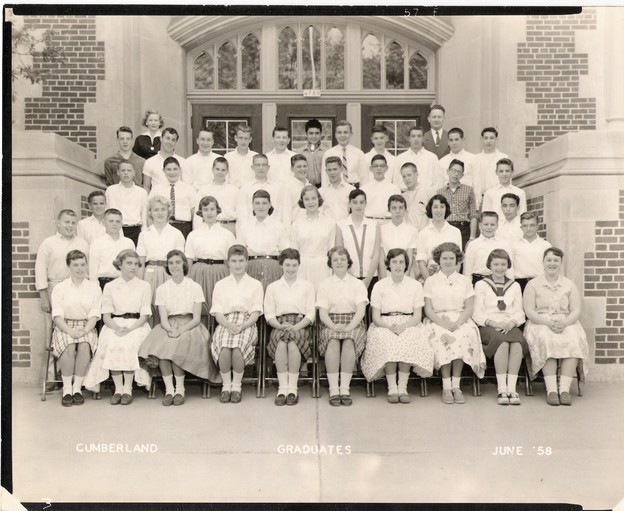
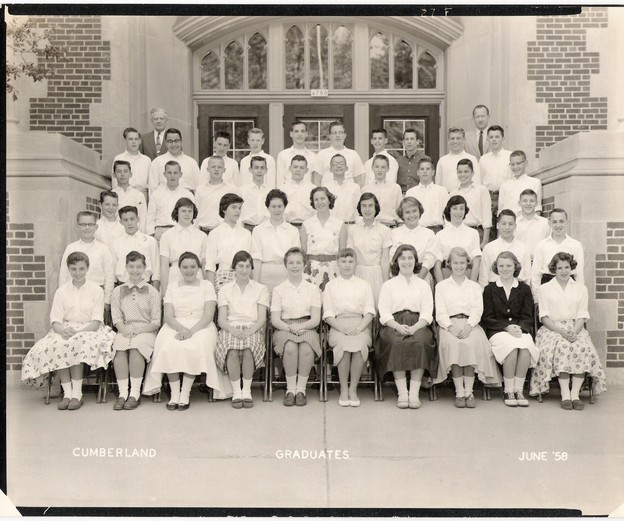
Had to post the photos from the 1958 Cumberland graduation class, as it reminded me of those earlier years and all the good friends we made. I also found the obituary for Mr Romano, and remember spending many hours visiting with Jill's sister Pam and her mother and father. Thank you for your response.

In Memory of

Louis Romano

 
January 1, 1921 - September 30, 2013
Obituary
 
Louis Romano Okemos, Michigan Louis Romano, Professor Emeritus at MSU, passed away September 30, 2013 at the age of 92. He was born January 1, 1921. Louis was raised in the 3rd Ward Immigrant neighborhood in Milwaukee, Wisconsin from an Italian family headed by a single mom, Marie Pelligrino Romano. Louis is the last survivor of 5 siblings, Tony Romano, Joan Romano Blazevic, Robert Romano and Nina Romano Galipo. His wife Shirley preceded him in death in 2003. Lou is survived by his daughters, Pam Dilley of East Lansing, MI and Jill Stryker of Falls Church, VA. Pam's two sons, Brett of Cincinnati, OH and David (Erin) and their son,...

12/24/16 12:09 AM #66    

Janet Hindin (Volat)

Hi Dave, JoEllyn, and Julie,      

Thanks so much for your responses and Dave for posting the class photos. They are priceless. I forwarded your comments to Jill and she was so touched. She said to give her best to everyone.  Dave, she was especially touched that you posted her dad's obituary. He was definitely one of a kind.

Janet Hindin Volat


12/24/16 05:39 AM #67    


Michael Gordy

Happy New Year, everyone. Here below is a copy of the short speech I was asked to give at my Carleton 50th reunion last June. The topic was supposed to be "Facing an uncertain future", and the audience seemed to find what I had to say provocative. I'm sending it on because I think it may be helpful as we are forced to step away from the comforting assurances with which we have lived for most of our lives.


50th Reunion Talk

Carleton College, 16 June 2016


The subject of our meeting here is ‘facing the uncertain future’, which seems to imply that the uncertainty of the future is something new. But the future has always been uncertain, and if that really is a problem, it is a perennial one. A newer problem, and one that may be unprecedented, is the way that the future of humanity seems to have become increasingly certain over the past forty years or so. I’ve had a few thoughts about this that I’d like to share with you.

First of all, uncertainty about the future is the foundation of hope. No matter how bad things look, uncertainty allows us to believe that the future might hold some pleasant surprises, if not for us as finite, mortal individuals, then for the human race as a whole.  Second, some people try to relativize current problems by pointing out, for example, how dark things looked in the Western world in the 14th century, and how nonetheless humanity struggled through that time and eventually experienced a Renaissance. In that instance, of course, the Arab world and the Middle Kingdom conveniently kept the flames of culture and civilized behaviour alive, even   though our current punditry and Western-oriented scholars often don’t seem to think that this counts for much. So the West survived and now aspires to rule the world, or so it seems.

We have arrived at a stage of history where virtually the whole world is organized around a Western-originated system whose internal contradictions and material self- destructiveness are seemingly out of control, and where according to the system’s own logic it is unsustainable. In terms of human survival, that self-destructiveness is dragging us towards collective suicide.


Most of us who contemplate this are terrified, for we have been raised to think of the system as having a life of its own. We overlook the obvious fact that all social systems are the dynamic product of human interaction and that people acting together can in principle change all social relations. If we forget this fact, we become paralyzed, ensuring that a future that is still somewhat uncertain becomes certain. That seems to be what has been happening, but I think that things are starting to change. Before getting to this, however, let’s have brief look at several important features of our present reality. Two aspects of our current condition present particular terrors.

First is the economic system. Seen from the perspective of private monetary accumulation, which is the only metric that seems to count in capitalism, it is immensely more ‘profitable’ to speculate than it is to produce anything or to render any kind of non-financial service. Even sections of the business community recognize that this is unsustainable, but there are few serious ideas being put forth in that world about what to do about it. The inherent individualism and competitiveness of business practice makes a concerted, collective response from the top extremely improbable and, for most people, hardly imaginable. Everyone at the highest levels of the financial and corporate elite seems to be scrambling to grab as much as they can for themselves before the inevitable collapse occurs.

Second is the environment. Can we preserve a minimal physical environment that will allow humans to survive? The private accumulation of monetary profit makes that goal a fool’s errand. Any effective, widespread action just does not make “business sense”. For the past five years I’ve consulted with the World Meteorological Organization about the economic and political barriers to meaningful responses to climate change. This has led me to the brink of despair. I have concluded that “business sense”, like “business ethics”, is an oxymoron when applied to human survival.

The inescapable connection between what we call ‘our way of life’ and the rapid acceleration of all forms of environmental degradation should be obvious to any one of us who opens his or her eyes to the world and remembers what our physical environment was like when we were kids. The explosion of consumerism fuelled by the post-war


boom that many of us Americans enjoyed was expressed ideologically as the worship of ‘growth’, with little thought about what growth means, both environmentally and socially, when it is not subordinated to the need all of us have for a peaceful, healthy, equitable, and just life.

The boom times of our youth spoiled us and gave many of us a rather superficial sense of hopefulness. After all, we lived in a country that was the most powerful in the world, both economically and militarily. Ours was a life of possibility, especially if we attended an elite school like Carleton. Environmental degradation was not part of the dominant discourse then, nor did most of us have any idea of the effects our boom times had on so many parts of the rest of the world. So the subsequent disintegration of what we had felt was the normal course of things has come as a shock, shaking our sense of the uncertain future that I said was a foundation of hope. That is why, as the future begins to look terrifyingly certain, we mistakenly think of it as increasingly uncertain.

We grow old, and the hopefulness of our youth has passed into history along with the boom times. We worry about the future because, although we are near the end of the line, there are people we will leave behind whom we care about. And we sense that finding meaning in the present is pretty much impossible if we really believe there is no future for the human race. So what can we do?

The first thing we can do is to think about what is happening from new perspectives, opening ourselves to a more systemic and historical understanding of what is happening to us as a species. We can all do this by talking with each other and by expanding our conversations to include people who may not be part of our usual circle of interlocutors. If we really are people capable of making “critical and independent judgments” as claimed in the Carleton catalogue of our youth, and if we are capable of critical self-reflection as well, then what I’m suggesting is already part of our lives.

The second thing we can do is to recognize that piecemeal changes and tinkering simply will not do the job, and that a


far-reaching transformation of the way we produce, distribute, and consume on this planet is everyone’s most urgent task. If we do not do whatever we can to contribute to this, according to our present capacities, then that transformation will occur anyway but without our participation, and it will most likely have characteristics we will abhor. Without such a transformation we will be facing either a complete monetary breakdown, with all the suffering that this implies, or, if we continue on the path we are on, the destruction of the environmental basis of human life.

The first alternative is the more hopeful one, since if money loses its value, as would occur in a global monetary collapse, this will not mean that there won’t still be things to do, materials to do them with, and people who know how to do them. What it will mean is that the world’s social relations, insofar as they are based on money, will collapse. The things people do for money they will no longer do, and relationships based on the amount of money one has will be finished.  New social relationships, if they have a chance to emerge, will do so rapidly and will be based on two values that have little place in the present system except as pious hopes, namely, cooperation and sharing.  Must we await a global economic disaster to take steps in a positive direction? Or can we contribute to moving these values to the forefront now, even though we are in our dotage?

One of the more hopeful signs these days is that a great many people on the planet are beginning recognize the necessity for thoroughgoing change and starting to resist the direction in which we are headed. This resistance is opening up a space for people to think together about ways to stop the machine-like march towards human extinction. We need to enter that space. We need not only to think from the perspectives I mentioned earlier but also to seek openings to encourage and contribute in practical ways to this hopeful dynamic.

 I am well aware that what I’m suggesting does not constitute an answer. I’ve tried, however, to indicate first steps that people here can take. We know that ideas are powerful, and we must join together to contribute to ideas that offer at least the possibility of returning us to the uncertainty of the future. But we are also obliged to do what we can to help implement those ideas.  We must not allow a ‘certain’ future to overwhelm us. We are not permitted to ‘retire’.


go to top 
  Post Message
  
    Prior Page
 Page  
Next Page